
Keyword Mapping: How to Structure Branded and Non-Branded Pages
Keyword mapping assigns one target keyword to every URL so your own pages stop competing. How to structure branded and non-branded pages so each one can win something.

Throwing your target keywords randomly across a website guarantees one thing: search engines will have no idea which page to rank. When two or three of your own pages chase the same term, they do not team up. They compete, and they drag each other down the results. That is the problem keyword mapping solves.
Keyword mapping is the process of assigning one primary job, and one specific target keyword, to every URL on your site. It builds a strict hierarchy a search engine can read without guessing. This page owns the brand. That page owns the service. This other page owns the how-to question. Each URL has exactly one job. Done well, every page pulls in one direction instead of fighting its neighbors. This guide walks through why your architecture needs those boundaries, how to structure branded pages and non-branded pages differently, and how to find and fix the keyword overlaps quietly holding your site back.
Why does site architecture need strict keyword boundaries?
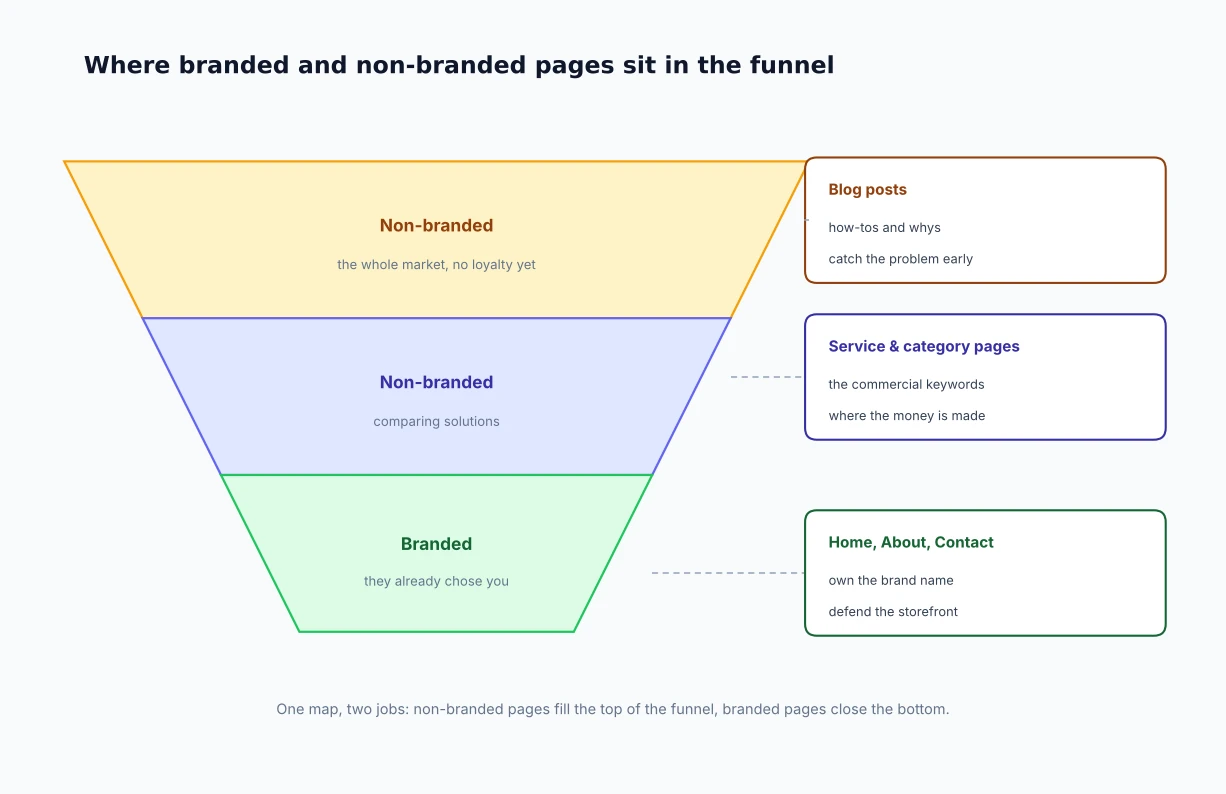
It needs them because searchers arrive with two completely different mindsets, and a single page cannot serve both well. Some people already know who you are and search your brand name. Others know only the problem they have and search for a solution, with no idea you exist. Your site must cater to both intents, but never on the same page, because the on-page signals that win one actively weaken the other.
A keyword map is how you enforce that split, and at its simplest it is a spreadsheet. One column for the URL, one for its target keyword, one for the search intent behind it. That is the whole artifact. Now the core rule: every page gets exactly one primary focus. The moment a page chases your brand name and a broad service term at once, it dilutes the relevance of both. A diluted page rarely wins anything.
Building the map itself is a short, repeatable process. List every URL on the site in one column. Beside each, write the single keyword that page should own and the intent behind it, whether the searcher wants to navigate to you, buy a service, or learn something. Where two rows end up with the same keyword, you have found a conflict to resolve before it ever reaches Google. The spreadsheet is boring and that is the point. Boring is what a search engine can read.
One nuance trips people up: what counts as "the same" keyword. Modern search understands meaning, not just exact strings, so "pipe repair" and "fixing pipes" are the same target as far as Google is concerned, and two pages built around them will still cannibalize. Map by intent, not by spelling. If two pages would satisfy the same searcher with the same answer, they are competing, however differently you worded the title. The test is simple: could one page reasonably replace the other in the results? If yes, merge or re-scope one of them.
How should you structure your branded pages?
Branded pages are your digital storefront, and their job is to capture people searching specifically for your company. These are the bottom-of-the-funnel visitors who already decided to look you up, and the pages that serve them are your branded anchors: the homepage, the "About Us" page, and the "Contact" page.
Give those pages the brand, fully and without apology. The homepage H1 should state your brand name and your core offer in one clear line, and the title tag should follow the format Brand Name | Core Value Proposition, something like Acme Plumbing | 24/7 Emergency Plumbers in Chicago. That captures the branded search cleanly and tells a first-time visitor what you do in a single glance.
One warning saves a lot of wasted effort here. Do not try to make your homepage rank for a fiercely competitive national keyword like "plumbing services." The homepage is about your brand. It lacks the specific topical depth to beat pages built entirely around that one service. Chasing it only blurs the brand signal the homepage should own, and loses the national term anyway. Let the homepage be the best possible answer to your name. That is a fight it can win.
How should you structure your non-branded pages?
Non-branded pages are the nets that pull in new business, and their job is to capture people searching for a solution before they have ever heard of you. This is top-of-the-funnel discovery traffic, and the pages built for it are your service pages, your product categories, and your blog. Each one should target a specific non-branded keyword that nobody else on your site is chasing. The blog deserves special mention here, because it carries the informational long tail, the how-tos and the whys people search long before they are ready to buy. A post answering "how to fix a leaking pipe" catches someone with a problem, builds a little trust, and leaves a path toward your commercial repair page. Blog posts rarely convert on the spot, and that is fine. Their job is to widen the top of the funnel and feed topical authority to the money pages below them.
The on-page strategy inverts everything the homepage does. The target keyword should dominate the H1 and the URL slug, so a commercial plumbing page lives at /commercial-plumbing-services with an H1 built around that exact phrase. The brand name moves to the very end of the title tag, or disappears entirely if space is tight. Write 24/7 Commercial Pipe Repair in Chicago | Acme rather than Acme Commercial Plumbing Services. The front of the title carries the most weight. You want a buyer's search term there, not a name they have never typed. This is the same discipline behind our argument that ranking for your brand name is only the starting line, and getting the title and H1 right on every page is the backbone of a strong on-page SEO foundation.
How do you find keyword cannibalization and fix your map?
You find it by listing every page's title and H1 in one place and spotting where two pages target the same keyword, then you fix it by reassigning or merging the weaker page. Cannibalization is what happens when the map goes missing and the architecture gets messy. Picture a blog post titled "Why Acme Is the Best" and the Acme homepage, both aggressively targeting the word "Acme." They are not helping each other. They are splitting the brand signal, and a confused search engine often responds by demoting both.
Here is the practical obstacle. Spotting those overlaps by hand on a 300-page site means opening every page, reading the browser tab for the title, and inspecting the code for the H1, page after page, until you lose the will to finish. Nobody completes that audit manually, which is exactly why cannibalization goes unnoticed for years.
A local crawl removes the drudgery entirely. Crawlpit Monster crawls your whole site and exports every URL, title tag, and H1 into one clean, sortable list, so duplicate targets jump out the instant you sort the column. You can see at a glance which pages are fighting over the same keyword. From there, the fix is one of three moves. Reassign the weaker page to a different, more specific keyword it can actually own. Merge two thin pages into one strong one and redirect the loser. Or, when both URLs must stay, use a canonical tag to tell Google which version is the master. Then rewrite the titles and H1s to match the map, one page per term.
Export every URL, title and H1 in one pass
Sort the column and the duplicate targets jump out, turning the keyword map from a manual survey into an afternoon's work.
Stop competing against yourself
A cleanly mapped site stops wasting its own strength. When every page owns one keyword and one job, your branded pages secure your reputation and your non-branded pages act as nets for new business, and no page undercuts another. That is the quiet power of keyword mapping: not a clever trick, just the end of self-sabotage.
Build the map as a simple spreadsheet, assign one keyword and one intent to every URL, and keep branded and non-branded terms on separate pages. Then crawl the site with the on-page audit to confirm reality matches the plan, because a map only helps if your live titles and H1s actually follow it.
And treat the map as living, not finished. Every time you publish a page or launch a new service, add its row and check that its keyword is not already claimed. Sites rarely get cannibalized in one bad decision. They drift into it, one unmapped page at a time, until two dozen posts quietly chase the same term. A quick re-crawl before each launch keeps the hierarchy clean as the site grows. Clean architecture is what lets each page finally rank for the thing it was built to win.
Charlie Varma
Charlie Varma is a technologist, author and digital marketing strategist with 17 years of experience across technology, search engine optimization, performance marketing and go-to-market strategy. He approaches SEO as a combination of data, search intent, technical structure and informed decision-making rather than a collection of shortcuts.
Charlie writes about search engines, SEO tools, technical audits, keyword research, content strategy and performance analysis. He is also the author of two books covering AI SEO and marketing funnels. Known for separating useful insights from vanity metrics, he turns rankings, traffic and search data into practical actions that businesses and marketing teams can use.